
Should You Mulch, Rake or Bag Your Leaves in Northeast Ohio?
Mow them in, rake them up or bag them for the curb? A Warren crew's plain answer, backed by Ohio State and Purdue research and the city pickup rules.
Published November 5, 2026 by the Phillips Care Landscaping crew, Warren, OH. More guides
Phillips Care Landscaping · Warren, OH
Mulching leaves with a lawn mower is good for your lawn when the layer is thin and dry, and it saves you a weekend of raking. Once leaves pile up past about 2 inches, or you can't see grass through them, rake or blow them off and bag them. Thick, wet leaves left on the lawn through a Valley winter smother the grass and invite snow mold.
Key Takeaways
- Ohio State Extension advised in 2023 that leaf cover deeper than 2 inches should be removed or mulched over and over.
- Mulch at your normal height, about 3 inches, and only when leaves are dry.
- Warren only picks up leaves in paper bags. Youngstown handed out free leaf bags last season (2025).
- Big maples, oaks and wooded lots usually need two fall visits.
Every fall we get the same question in Warren, Niles and Youngstown: can I just mow over these? Sometimes yes. This guide shows where the line is, what the research says, and how bagging at the curb fits each town's pickup rules. If you would rather hand the whole job off, our leaf removal and fall cleanup service covers lawns across Trumbull and Mahoning County.
Mulching, raking and bagging at a glance
Mulching chops leaves into the lawn, while raking and bagging move them to the curb. In 2013, Purdue turfgrass specialist Aaron Patton wrote in What To Do With All Those Falling Leaves? that mulching works for a moderate leaf drop, but leaves thick enough to hide the turf should be raked.
| Method | Best for | Time and effort | Watch out for |
|---|---|---|---|
| Mulch with the mower | Light, dry leaves on open lawn; a yard with one or two trees | Least: a weekly mow you already do | Wet leaves clump; deep layers pack into a mat |
| Rake or blow, then bag | Thick drops under big maples and oaks; leaves in beds and fence lines | Most: hours of raking plus bags to fill and set out | Takes the most time; bags must match your town's rules |
| Mix of both | Most Valley yards: mulch in October, clear the heavy drop in November | Medium: mowing in October, one big clearing later | Needs the timing right before the first snow |
Is mulching leaves with a lawn mower good for your lawn?
Yes, in moderate amounts. Purdue's 2013 research summary found oak and maple leaves can be mulched into turf without hurting soil or grass, and without adding thatch or disease. In 2001, Purdue's Zachary Reicher also found, in a Purdue News report on leaf mulching, mulched leaves did not change grass color or quality.
The catch is size. Iowa State University's Yard and Garden team, in an answer updated in October 2025, says the chopped pieces must be small enough to fall down between the grass blades. When you're done, you should barely see any leaf bits. If you still see a brown carpet after one pass, mow it again or start raking.
Mulching also keeps leaves out of the bag count. That matters in towns with bag rules, which we cover below. It does not replace clearing beds, fence lines and the driveway, where a mower can't reach.
How many leaves are too many to mulch in one pass?
About 2 inches is the line. In a November 2023 fall lawn care post, Ohio State University Extension's turf team said leaf cover over 2 inches should be removed or mulched with repeated passes, or it will rot on the grass. Purdue's Reicher put it bluntly: 6 to 8 inches at once just won't work.
Our crew uses a simpler test on Valley lawns. Can you see green between the leaves? Then mow them in. Is the lawn gone under a solid layer? Rake or blow first. Yards under big silver maples, pin oaks or a wooded back lot almost always cross that line by early November. Those leaves come down in one heavy drop, and a mower just presses them flat.
Mulching early and often helps. Mowing once a week through October chops each new layer while it's thin. Wait until the whole tree is down and you're back to raking.
How high should you set the mower to mulch leaves?
Leave it at your normal fall height, around 3 inches. Purdue's turf team wrote in a December 2021 note on mowing and leaf removal that lawns should stay at 3 inches or higher until the grass goes dormant. Mowing up to dormancy also chops late leaves, which may help prevent snow mold.
Two more settings matter. Take the bag off, or close the side chute if your mower has a mulching plug. And only mulch dry leaves. Purdue says dry leaves mulch much more easily than wet ones, and wet leaves clog the deck and leave clumps behind.
For the very last mow of the year, Ohio State Extension suggests stepping the height down to 2 to 2.5 inches, about half an inch at a time, especially on lawns with a history of snow mold. Never scalp it in one cut. Our weekly lawn mowing service handles that step-down for you through the fall.
When is raking and bagging the better call?
Rake and bag when the leaves are deep, wet or sitting where a mower can't go. That means the heavy November drop under big trees, leaves packed into flower beds and along fences, and anything on the driveway or walks. Ohio State Extension's 2023 guidance is clear that a thick layer has to come off one way or another.
Bagging also makes sense for yards that back up to woods. Leaves keep blowing in for weeks, so you're dealing with a constant supply. Clearing them off and bagging them means the lawn gets light before the snow arrives.
A lot of homeowners mulch the front and bag the back. That's usually the right split. Plenty of front lawns have one street tree, while the back lot is where the oaks and the woods line sit.
Do leaves left on the lawn over winter kill the grass?
A thick layer can. Purdue's Reicher warned in 2001 that whole leaves left on top of grass block photosynthesis and hold in the moisture that leads to snow mold. Ohio State's turf pathology team wrote in a March 2025 snow mold update that pink snow mold is probably the most common snow mold in Ohio.
Snow cover makes it worse. Ohio State says gray snow molds most often show up when snow cover lasts longer than 40 to 60 days. Our count of NOAA daily records for Youngstown-Warren Regional Airport, using the 27 winters from 1990 to 2020 with complete records, found an average of 58 days a winter with at least an inch of snow on the ground. Those days rarely come in one unbroken stretch, but wet leaves under them are a bad mix.
On spring cleanups, we can usually tell where leaves sat all winter. The grass there is matted, thin and sometimes crusted with a gray or pinkish patch. It often fills back in, but it starts the season weeks behind the rest of the lawn. A spring cleanup rakes out that matted layer so new growth can come through.
How curbside leaf pickup works in Warren and Youngstown
Each city sets its own rules, and bags that break them get left behind. Warren's Environmental Services Department, in its June 2025 collection flyer, says leaves set out for pickup must be in biodegradable paper bags, not closed with tape or twist ties. Leaves in any other bag or box won't be picked up.
Youngstown works differently. Last season (2025), the city's Green Youngstown office, per its 2025 leaf collection guide, handed out 25 free leaf bags per household at 9 W. Front St. Curbside collection ran October 27 through December 6, on Mondays, Wednesdays and Fridays. Bags had to be at the curb by 7 a.m., and residents called 330-744-7526 to say their bags were out. Leaves only, with no sticks or trash. Check the city's notice for the 2026 dates and bag pickup.
Townships like Austintown, Howland and Liberty set their own schedules, so check yours before you fill a bag. If you live in Youngstown, our Youngstown lawn care and leaf removal page covers the neighborhoods we work in.
What a two-visit fall cleanup looks like
Two visits catch both leaf drops. Most Valley trees let go from late October into November, but oaks hang on and keep dropping into December. One cleanup in mid-November leaves those late oak leaves on the lawn all winter. That's why our fall leaf cleanup is built around two visits.
- Early November visit. We clear the lawn, pull leaves out of beds and from around shrubs, and blow off the driveway, walks and steps.
- Late visit, after the last leaves fall. We clear the late oak drop and give the lawn a final mow so it goes into winter at the right height.
- Bagged at the curb. Leaves are bagged and set at the curb for your town's pickup. We don't haul them away.
Yards with only a tree or two may need just the second visit. Tell us what's overhead when you call and we'll say which fits.
So which should you do this fall?
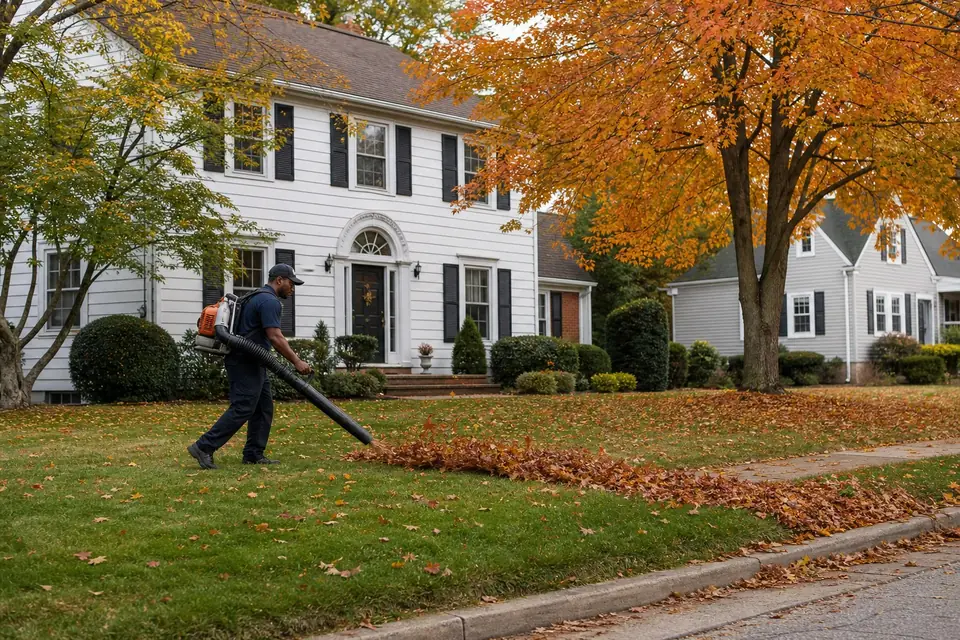
Mulching leaves with a lawn mower works while the layer is thin; clear the heavy drop by hand. That's the short answer for most Warren and Youngstown yards. Keep mowing at about 3 inches through October and chop each light layer as it lands. Once the big maples and oaks let go, rake or blow, bag for the curb and finish with a lower final mow.
Whichever way you go, get the lawn clear before snow sits on it. In our count of those NOAA records, the median first measurable snow at the airport landed on November 7. If you would rather skip the raking, call or text (330) 353-9809 or ask for a free leaf cleanup quote.
Frequently Asked Questions
Is it okay to leave mulched leaves on a lawn?
Yes, if they are chopped small enough to fall between the grass blades. Iowa State University Extension says very little leaf debris should be visible when you finish. Finely mulched leaves break down over the winter and add organic matter. Whole leaves or a thick layer of chopped ones are different, because they can mat down, block light and hold moisture against the grass.
Can I shred leaves with my lawn mower?
Most rotary mowers can shred leaves, with or without a mulching blade. Take the bag off, keep the deck around 3 inches and mow when the leaves are dry. Go over the area twice if pieces are still large. A mulching blade or plug cuts them finer, but a regular mower works for a light layer. Wet leaves clog the deck and clump.
How high should I set my mower to mulch leaves?
Keep it at your normal fall height, around 3 inches, which is what Purdue University turf specialists recommend until the grass goes dormant. Mowing much lower to grab more leaves can scalp the lawn. For the final mow of the year, Ohio State Extension suggests stepping down to 2 to 2.5 inches, about half an inch at a time.
Do I have to rake leaves in Ohio?
No law makes you rake, but a thick layer left all winter can thin your lawn and lead to snow mold, according to Purdue and Ohio State turf specialists. If the leaves are light, mowing them in works. If they are deeper than about 2 inches, take them off the lawn. Leaves in beds and on walks should come out too.
Does Warren, Ohio pick up leaves in plastic bags?
No. Warren's Environmental Services Department says leaves and grass set out for pickup must be in biodegradable paper bags, closed without tape or twist ties. Leaves in plastic bags or boxes will not be picked up. Other towns in Trumbull and Mahoning County set their own rules, so check with your city or township before you bag.
Get Your Free Quote
Call or send the form with your address and the work you need. We look at the property and give you a clear price before any work starts.
- Free quotes, no pressure
- Locally owned in Warren since 2012
- Insured for landscaping and snow work
- Lawn, landscaping and snow from one crew
- Trumbull and Mahoning County